ECHAsystem
Organisational sustainability framework
Take part in the research
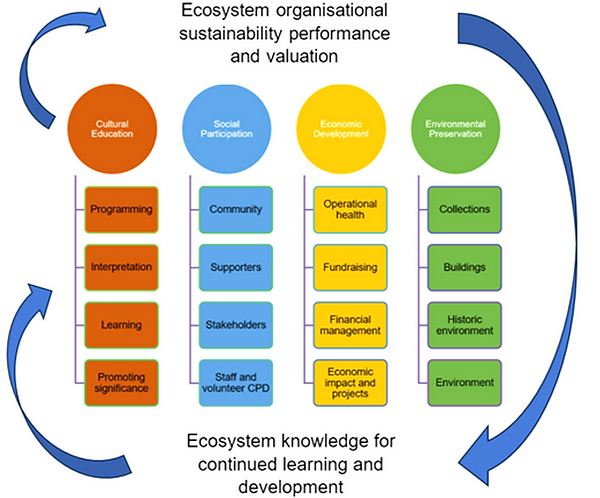
The organisational sustainability framework is described below.
To use it: assign priority operations, check the operations against knowledge enablers, and measure your performance for each operation by using qualitative and quantitative indicators. Then use your performance as a guide to improve your knowledge base, in a continuous cycle of improvement.
Take part in the research
Organisational sustainability is defined as the continued ability of an organisation to achieve its cultural, social, economic, and environmental objectives, by ensuring its people have the practical knowledge and technological tools to perform their roles and to provide value co-creating quality service.
There is an invaluable diversity of historic Environment, Culture, Heritage, and Arts (ECHA) which needs to be protected. The Burra Charter highlights that no one cultural or natural value should benefit on the expense of another, and we should safeguard a rural or underrepresented community tradition or heritage asset as much as another. Additionally, this diversity builds a place’s capital. Loss of this diversity results in depreciation of cultural, social, economic, and environmental capitals. Curating the diverse ECHA, therefore, requires a diversity of ECHA organisations that sustain and grow such capitals. This diversity, however, is under threat as its organisations have been in a protracted crisis.
Currently, there is a sectorial representation of these organisations, as it provides a means for the allocation of government and grant funding. The sectorial representation, however, can create competition for limited resources, and fragmentation, segmenting any economies of scale. Accordingly, operational knowledge in competitive settings becomes a leading innovation organisational resource that is protected from competitor organisations and sectors, rather than shared. In the organisational sustainability framework, these organisations operate as an ecosystem, ‘the interaction between organisms living together in a particular environment’, and, instead of sectors, the organisational areas are better described as habitats, comprising the resources available to a population in a specific ecosystem environment.
This diversity of the ECHAsystem is represented in 15 habitats:
1) Arts and crafts, 2) Archives, 3) Archaeological sites, 4) Aquariums and zoos, 5) Castles and palaces, 6) Countryside, coast, marine heritage, 7) National parks and botanic gardens, 8) Galleries, 9) Historic houses and buildings, 10) Libraries, 11) Museums, 12) Theatres, 13) Music, other performative arts, 14) Theme parks, historic sports, 15) Artists, freelancers, consultants.
These habitats have four common objectives: education, participation, development, preservation. The ECHAsystem organisational sustainability framework combines:
1) the four pillars of sustainable development that reflect the four UNESCO’s thematic indicators (cultural, social, economic, environmental); and
2) the four common intergenerational, public-good objectives in the 15 habitats (education, participation, development, preservation).
Representing the four organisational sustainability objectives as pillars, offers a very useful analogy. The knowledge required can be presented as the base, the strong foundations needed to build the pillars upon. The main operations are presented as four drums, which are the stone sections of the pillar. Suboperations are referred as flutes, the decorative elements of the pillar. And above the pillar is the capital, relating to the value capital created by each of its four objectives.
Based on evolutionary organisation theory, the framework enables continued improvement: the interaction of experiential and recorded knowledge enable improvement of routines and operations, and the improved operations deliver objectives which enrich the value capitals. Ongoing review of the values enables the improvement of the knowledge base and learning processes, bringing a cycle of continued improvement.
Utilising extensive literature review and piloting, the ECHA operations have been grouped in four drums for each objective:
Each organisation or site, can assign a suitable number of priorities, reflecting its uniqueness. There are nearly 21 trillion variations (20,922,790,000,000) to select the priority of 16 operational drums, which can reflect the diversity of the organisations. It is proposed that organisations group the operations in high, medium, and low priority, for example. (e.g. 6 priority operations as high, 5 as medium, and 5 as low priority). This mapping reflects your site's or organisation's fingerprint. Every site and organisation has a unique fingerprint, depending on its habitat, location, size, governance, funding model, interests, team size and knowledge, ownership of collections, buildings, and landscapes (or not), accreditation status, and so on. Using the 6-5-5 model, enables the organisation or site to focus on key priorities. There are 2,018,016 unique ways to assign your 16 operations into 6 high, 5 medium, and 5 low priority categories.
Each site can assign performance indicators for each of their operations. It is recommended that at least one qualitative and one quantitative indicator is assigned for each operational drum, or its sub-operations (flutes). For example, (appreciating and responding to) visitor feedback, and visitor numbers, can be used as visitor indicators (flute) within the supporters' (operational drum). Future research will build a recommended list of such indicators for each habitat to make it easier to assign performance indicators.
Knowledge enablers can be used for each sub-operation (flute) and operation (drum). The findings and discussions pages provide useful information for different habitats, types of management, operation/team/ visitor sizes, and so on. In those pages there are also tables with useful resources, beneficial software, and so on. A list of general knowledge enablers for user (curating) and provider (support) organisations is included below. The list will continue to evolve with further research, and forms a quick guide. It is recommended that the full findings are explored, to shape a list of enablers that suit your organisation's or site's unique fingerprint.
Knowledge Enablers per operational area (drum)
Operational knowledge users
Have presence of few, authoritative, up-to-date knowledge artefacts (a variety of accessible formats with recorded knowledge, such as digital templates, printed manuals, or short films).
Knowledge artefacts are available in a range of formats to suit learning styles and access needs.
Everyone (every member of staff and volunteers) has access to the knowledge artefacts they each need to deliver their roles expertly.
There is a list of all knowledge resources, which everyone can access to see what knowledge resources are available to them.
Creation of new knowledge artefacts is best as a combination of using existing reliable templates and getting advice from your team and support networks.
Source knowledge artefacts from authoritative and trusteed sources.
Up-to-date knowledge artefacts are twice as effective. Keep a modest library of knowledge artefacts, focusing on priority operations, and make sure what you have is up-to-date and of high quality.
Use an updating matrix to choose how often you should update your knowledge artefacts. This way you only update them as often as necessary, but also do not put it off. Updating is about bringing the new and team-wide knowledge to your recorded knowledge, not a paper exercise.
Have an updating list for all the knowledge artefacts, with named lead person, and date for updating. Add updating in the calendar so you get a reminder, and it becomes part of the day-to-day work, not extra.
If you are part of a traditionally bureaucratic system (e.g. local authority, university, etc.), maximise the general resources available from the other departments (e.g. HR knowledge resources), and look at your networks for specific knowledge artefacts.
Find ways to have authoritative external knowledge resources approved so they can be officially adopted and fully utilised.
Recorded or experiential knowledge? The smaller your team (and visitor numbers), and the least experienced the team is, the more it will rely on knowledge artefacts and external support.
Engage your team when updating knowledge artefacts. Enrich knowledge artefacts with experience, not with rules.
Access ECHAsystem support.
Large teams, and multi-site organisations, can rely on their people's expertise more, and often treat the knowledge artefacts as management tools, rather than knowledge sources.
Large teams with better levels of useful, updated knowledge artefacts, perform even better.
In volunteer organisations, even one paid member of staff can provide significant stability and expertise. If managed as part of a diversified funding mix (ideally around 2/3rd self-generated funding) then the performance improvement is likely to pay for the cost of the paid member of staff.
A diversified funding mix of 2/3rds self-generated funds and the rest equally split between grants and other government funding/ benefits, appears to create the most sustainable operations and performance.
Across the four organisational sustainability objectives, aim to achieve at least a basic standard in those that are not priorities. Understand whether your focus is mainly cultural/social (intangible objectives), or economic/preservation (tangible objectives), and do not ignore the other type completely.
Fully trained teams of staff AND volunteers, perform 71%-81% higher. Training all your people is the most significant factor for improving the site's/organisation's performance. Make training an empowering part of the role, not additional work or a chore.
Demonstrate your commitment to your people, by having an appropriate induction and ongoing learning plan for every member (staff and volunteers). Personalise it, if they want to learn about one particular topic, help them focus on that.
Have a training budget. Apply for grants for training courses. Having a training budget can improve organisational sustainability performance by 26%.
Using a Enterprise Resource Planning (ERP) or Customer Relationship Management (CRM) software system, can increase organisational sustainability performance by 30%, especially if it is specific for ECHA organisations (general council/other systems create improvement but only modest in comparison).
Software use across the operational areas can increase organisational sustainability performance by 52%. See technological section for lists of beneficial software that participants have been using.
Integrate project-created knowledge artefacts in the site's knowledge library before the project ends, and add them to your updating list.
Have quality up-to-date knowledge artefacts for every priority operation and suboperation.
Appoint four lead persons (trustee/ manager), one for each of the four objectives.
Agree a suitable number of priorities, depending on your organisation (e.g. 6 priority operations as High, 5 as medium, and 5 as low priority). This mapping reflects your site/organisation as your fingerprint. Every site and organisation has a unique fingerprint, depending on its habitat, location, size, governance, funding model, interests, team size and knowledge, ownership of collections, buildings, and landscapes (or not), accreditation status, and so on.
Review the enablers and performance for each operation
Operational knowledge providers
Provide high quality, not high quantity, knowledge resources (training, expert support, and knowledge artefacts).
Provide knowledge artefacts in a range of formats to suit learning styles and access needs.
Develop your resources in discussion with other providers, so that the resources are complementary, easy to use and find. This will enable organisations with limited capacity to benefit from the complementary impact.
Provide a list of your available resources, including those behind membership walls, so that people can find out what there is, and other organisations do not duplicate the same ones.
Do not rely on signposting to lots of other resources. Signposting is creating a messy web, rather than providing a comprehensive package of supported knowledge resources.
Show clearly which knowledge resources are your recommended resources.
Ensure all open access resources clearly state they have such licence, so that everyone feels safe to copy and adapt them.
Ensure links to knowledge resources work. Use website functions to detect broken links.
Have an updating list for all the knowledge resources, with named lead person, and date for updating.
Add updating in the calendar so you get a reminder, and it becomes part of the day-to-day work, not extra.
Have a gaps and feedback process to find out what knowledge resources are needed, how useful they are, which and how much they are used, how easy they were to find and use. Evaluate what difference they made (before providing and after).
Make the websites user-friendly, welcoming, fun. Prioritise the human contact and support, rather than simply linking to rules and regulations.
Have a streamlined your website. Make it easy for users to navigate to quality, rather than getting lost in quantity.
Provide complete packages of support, not isolated resources.
Be accessible through human contact, not just apps.
Focus the provision on complete packages of training and expert support, and access to that support, rather than developing lots of knowledge artefacts. Treat knowledge artefacts as training tools, not marketing drivers.
Focus on developing support packages that fill long-term needs, not isolated knowledge resources for quick-wins.
Apply for grants to develop long-term training courses and associated resources.
Apply for grants to train your trainers and resource developers. Apply for grants to upgrade your (knowledge artefact media and training) software
Develop two tier resources, i) a proactive plan to inform operations across the objectives and operational drums, and ii) a crisis process for developing and disseminating knowledge resources at speed.
Find out what the individual user site/ organisation's priority operational drums are, and provide for those.
Organisational sustainability dashboard
Worksheets for recording enablers, performance criteria and rating, will be added here in autumn 2026.