Financial relations
Funding streams
Buildings
Collections condition
Promoting significance
Education and programming budget
Training budget
Funding streams: across the participants, the funding streams were split in self-generated income (55.0%), grant funding (17.5%), and government funding (27.5%) (Figure 6 47). At this split we have this research’s average presence of knowledge artefacts at 20.26%, updated level of 9.51%, and performance of 54.97%.
Setting each stream as dominant at 80% of the total funds, the self-generated income would relate to increase in knowledge artefacts levels with high level of con-version and the highest performance. Grant and government funding as dominant sources relate to drop in performance (Figure 6 48).
In 80% grant funding this drop might be due to the short-term intervention relating to low conversion levels of updated knowledge artefacts. With 80% government funding the presence of knowledge artefacts would be very high but conversion would be the lowest, perhaps impacted by bureaucratic processes associated with such funding stream. In modelling the data, none of the streams on its own (at 100%) would produce a higher level of knowledge artefacts or higher performance; a diversified mix led by about two-thirds self-generated income, supplemented by roughly equal grant boost and government funding (as security net perhaps) would relate to the highest levels of knowledge artefacts and highest performance combination.
Buildings: sites with buildings in very good condition had the highest levels of present and updated knowledge artefacts, and highest overall performance. Sites with build-ings below good condition had higher level of knowledge artefacts and overall perfor-mance than ones with good condition. This is perhaps because of grant funding inter-vention in buildings with poor condition, and needing and updating their knowledge artefacts more. In buildings in less than good condition, the Cultural education knowledge artefact levels dropped off (Table 6 2).
Additionally, as a data validation observation, the reported poor condition of the buildings (red areas below average) agrees with the low performance values provided by participants in the questionnaire.
The relation of building condition to knowledge artefacts and performance had similar results for the UK, revealing the positive impact of intervention on buildings with poor condition (Table 6 3). Similarly, with building issues, the condition of knowledge artefacts was poorer for Cultural education in the UK, showing perhaps lack of capacity, finances, or of physical space to deliver education and public programming. Conversion was high for the sites with buildings in disrepair, presumably related to funded works and need for knowledge artefacts for grant applications and for repairs.
Whilst repair needs and intervention positively affected knowledge artefacts and performance mostly in buildings with disrepair, an increasing maintenance budget had a direct increase relation with knowledge artefacts and performance. Sites with adequate maintenance budget had 61% higher presence of knowledge artefacts. Conversion to updated knowledge artefacts also increased with more adequate maintenance budgets, especially in the tangible operations, as one would expect. Performance reflected the rates of knowledge artefacts, sites with adequate budget showed a 16% increase in performance. Knowledge artefact levels and associated performance were positively affected more in the tangible operations (Table 6 4).
Collections condition: Sites with conservation works backlog had extremely low levels of present and updated knowledge artefacts. Their performance however was higher, potentially affected by grant funding intervention as their Economic development per-formance was the second highest of all levels. Overall, there was a clear positive rela-tion of knowledge artefacts and of performance, to the condition of the collection. That relation was not only in the tangible operations as seen with the buildings’ condition. The Social participation objective mainly, and the Cultural education, were also affected by the collection condition; improved collection condition was associated with higher levels of knowledge artefacts and performance in tangible and intangible oper-ations. This is understandable as collections in better condition are potentially used for public engagement, displays, formal and informal learning. Additionally, at sites with a collections’ budget, the knowledge artefact presence, updating, and perfor-mance were above average (Table 6 5).
When a collections budget was combined with accreditation, presence was 37% higher, updated knowledge artefacts 44% higher, and performance 5% higher. The largest increase was found with collections in very good condition, that had accreditation also. Then presence was 50% higher, updated knowledge artefacts 64% higher, and performance 24% higher (Table 6 6).
Having looked at condition and budgets relating to the tangible operations, budgets relating to intangible operations are examined next.
Promoting significance: there was strong relation between the level of budget for promoting a site’s significance and the presence of knowledge artefacts (43% higher presence), but small variation in updating (only 3% increase). This might be due to more commissioning-out of marketing and other promotional activities when there is budget available, rather than managing them inhouse. Overall performance was 20% higher in relation to having an adequate promotional budget (Table 6 7).
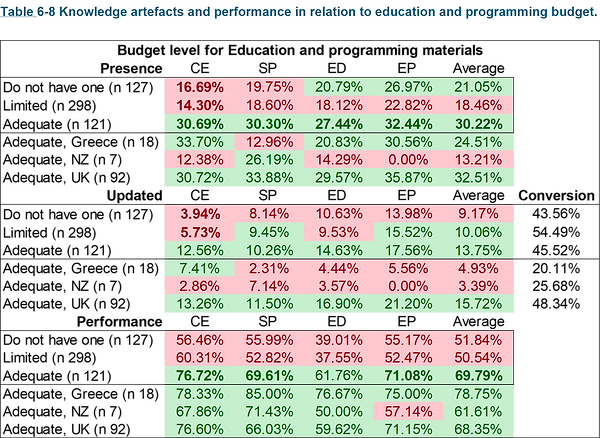
Education and programming budget: a budget for education and programming related to very high levels of knowledge artefacts and of performance. With adequate budget, presence was 44% higher, updated knowledge artefacts 50% higher, and performance 35% higher. The performance improvement was highest in the Cultural education objective as expected, but also across Social participation and Environmental preservation. The high performance in Economic development is not discussed as can be taken for tautology; as there is available budget, then the Economic develop-ment performance would be expected to be higher (Table 6 8).
Training budget: absence of a training budget had significant negative relation to knowledge artefacts and performance, particularly in the intangible operations. Conversely, sites with adequate training budget had 41% more present and 32% more updated knowledge artefacts, and 26% higher performance, compared to sites with no training budget. Conversion was higher in relation to a smaller budget; perhaps when lacking financial resources, the sites look after better the few knowledge artefacts they have (Table 6 9).