Know thy self: the sectorial pie
‘Is a Gilbert and Sullivan choir part of the heritage sector?’
(The Audience Agency and MyCake, 2024a)
The literature has shown culture, heritage, and environment being complementary, as cultural and artistic values enrich heritage assets, all residing within the his-toric environment. Where does the sectorial fragmentation originate from then? We need to look at a specific example, in this case the UK, to be able to understand the setting better.
The UK has the sixth largest economy (in GDP) (World Bank Group, 2024) and ninth highest number of museums in the world (Statista, 2024). Its culture, herit-age, arts, and creative industries are managed by the Department for Digital, Culture, Media & Sport (DCMS), a ministerial department supported by 45 agencies and public bodies (DCMS, 2022a). The DCMS funds two key non-departmental bodies:
• the Arts Council (set up in 1946 by Royal Charter, which was given a leading role following the disbandment of the Museums, Galleries, and Libraries coun-cil in 2011); and
• Historic England (previously known as Historic Buildings and Monuments Commission for England, and then as English Heritage before its separation from the now independent charitable body) (ACE, 2022b; Historic England, 2021b, 2021c).
DCMS also funds directly the 15 UK national galleries and museums (DCMS, 2019, 2024a). The DCMS’s cultural sector has a broad overlap with the creative industries, tourism, and the digital sector (DCMS, 2025) (Figure 7 2).
The Standard Industrial Classification (SIC) codes have been used for catego-rising industry activities within each sector (Companies House, 2025). The DCMS acknowledges that the overlapping and categorisation used for culture has ‘significant limitations due to the limited granularity of the standard industrial classifications’ (DCMS, 2025).
The cultural activities are spread under a wide range of SIC codes; arts, museums, libraries, archives, sport, ‘botanical and zoological gardens and nature reserves activi-ties’, and ‘amusement parks and theme parks’ are all under Section R (arts, enter-tainment and recreation). Tour operators are under Section N (administration ser-vices), and cultural education under Section P (education). Within the main section R, heritage occupies one understated sub-category code:
‘The Heritage sub-sector is depicted in our estimates by one SIC code “91.03 Operation of historical sites and building and similar visitor attrac-tions”… the published estimates are likely to be an underestimate for the Heritage sub-sector.’
The acknowledgement that the categorisation is not sufficient to estimate the cost and value of culture and its subsectors, alongside the lack of a common language and boundaries for these, came to the fore more intensely in the 2010s. The inability to collect performance data, demonstrate impact, or fund accordingly, was raised in re-ports and reviews (Alma Economics, 2024; Mendoza, 2018). One resulting project was the Arts Council’s Impact and Insight Toolkit, launched in 2019 (CountingWhatCounts, 2025; Culture Counts, 2019), and another project stream was the Culture and Heritage Capital (CHC) programme, launched by DCMS in January 2021 (Sagger et al., 2021). As part of the CHC programme, Historic England com-missioned The Audience Agency and MyCake to establish the size of the heritage ecosystem (The Audience Agency and MyCake, 2024a). The aim was ‘to bring a co-herence and shared purpose to data collection, sharing and analysis across the sec-tor’ (The Audience Agency and MyCake, 2024b, p. 73). The research approached heritage not through SICs classification but by including organisations across six do-mains that heritage has impact upon (advocating, researching, conserving, educating, engaging, and managing) (Figure 7 3).
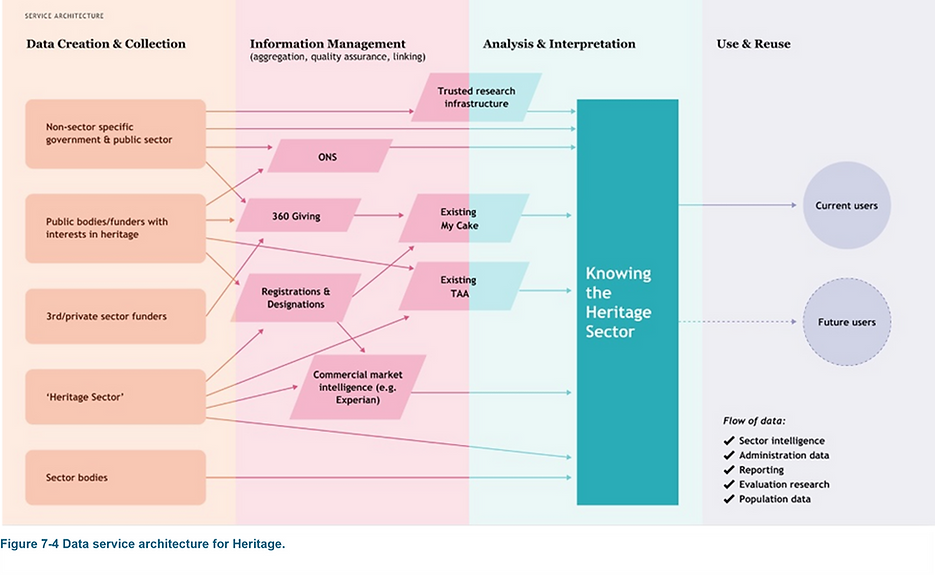
The flow of heritage data is then followed from data creation and collection, to infor-mation management, analysis interpretation, and use and reuse (Figure 7 4).
The organisation types usered are categorised as (Figure 7 5):
Non-sector specific and public sector.
Public bodies/funders with interest in heritage.
3rd/private sector funders.
‘Heritage sector’.
Sector bodies.
From these, the ‘heritage sector’ aligns with the user organisations (and freelancers) in this research, and the other four align with the provider organisations. By under-standing this alignment, it will be possible to relate the Knowing the sector work for Historic England with this knowledge curating design.
The Knowing the sector work is specific to the heritage habitat. More recent work within this programme includes the Arts, Culture, and Heritage (ACH) taxonomy project, which lists three of the five functional benefits of such classification systems as ‘a unifying language’, ‘improved knowledge transfer [of metadata]’ and ‘improved knowledge management’.
Whilst a review of the Arts Council had been in progress (DCMS, 2024b) it is noticeable that in the above taxonomy project the wording has expanded to include arts, alongside heritage and culture. This comes closer to the original conception of a museum in the antiquity, which incorporated the notions of a library, archive, and the arts (Sellars, 2023). What is not explicitly discussed, however, is nature conservation work and preservation. As mentioned earlier some nature organisations did not take part as they did not feel included in culture, heritage, or the arts. Key nature conser-vation organisations in the UK are funded by the Department for Environment, Food & Rural Affairs (DEFRA, 2025; Natural England, 2022; Natural England Designations, 2016), demonstrating further the sectorial fragmentation, created for financing and management reasons, rather than being a natural taxonomy (pun intended). But in daily life this is not a reflection of how such ecosystems evolve. One example can be a property from the National Trust, Europe’s biggest conservation charity (National Trust, 2025). A property may manage extensive collections within a historic building, and host indoors and outdoors cultural events, all within a managed natural setting of gardens, woodlands, farmsteads, and often coastlines or extensive countryside parks. How does one apportion its cultural and wellbeing benefits and costs, across art, or culture, or heritage without fragmenting its complementary operations? Translating the example at national level shows that a purely economist sectorial classification collapses the economies of scale and associated complementary unity, creates con-structed barriers, and unnecessary competition for resources within and across these not-for-profit ecosystems. As a result, culture’s reliance on grant funding ‘is creating a relatively benign environment … that hides the need for innovative, sustained change’ (Marks, 2018).
An awareness is needed that the Culture and Heritage Capital programme was fundamentally established due to important financing needs, rather than complemen-tarity opportunities, so it could result in ever deeper separation of the sectors. Whilst an economist factor is needed for economic appraisal and decision-making, sectoring can also have political motivations. Financial and social pressures have created a move towards ‘judicious withdrawal of hands-on government engagement’ across many countries, with privatisation of operations but ownership of heritage assets such as buildings and collection still under public ownership and legal protection (Throsby, 2010, p. 124). Purposeful sector fragmentation could be a means to divide (and con-quer) subsectors, prior to withdrawing hands-on engagement. During the austerity decade (2010s) in the UK, the disbandment of the Museums, Libraries, and Archives council (MLA) in 2012 (GOV.UK, 2012), was followed by a significant transition of state-managed cultural, heritage, and arts organisations to charitable status. This in-cludes the Canal and River Trust (previously known as British Waterways) (2012), Historic Royal Palaces (2014), English Heritage (2015), and many local museums (Canal & River Trust, 2022; Charity Commission, 2022; Historic England, 2021b; Mendoza, 2018). So, how does such shift towards independent organisations affect the Athena design?
The deductive analysis in chapter 4 shows that self-funding at around 67% re-lates to the highest levels of knowledge artefacts, and highest performance. Coupled with processual freedom which also relates to higher performance, a knowledge de-sign ought to support a judicious level of an independent ecosystem. A balance is needed for artistic, political, and processual independence without compromising hu-man rights to cultural participation due to creating financial barriers (of which paid en-try is a contentious one (AIM, 2023; Rex and Campbell, 2021), alongside ticketed events, and charged-for school visits). Several cultural, heritage, and arts support-organisations were historically set up to support a balanced transition of such organi-sations to independent status. Key examples include the Association of Independent Museums (AIM) established in 1977 due to the increase and continuing move of mu-seums to independent status, and The Heritage Alliance, set up in 2002 to promote heritage organisations’ move from government to independent status (The Heritage Alliance, 2020). The Historic Houses grew out of the British Tourism Authority in 1973 as an independent association and supports the thousands of independently owned historic houses in the UK (Historic Houses, 2025). Even in independently governed organisations, many collections and buildings remain under state ownership, whilst limited central and local authority finances are understandably prioritised towards health and emergency services. In the UK, local authorities had ‘a budget reduction of 27%, from £426m to £311m for museums and galleries in the decade between 2009/10 and 2019/20’ (Rex and Campbell, 2021). Local authority museums have been affected by the financial environment the most, in addition to having operational limitations in setting and managing their own budgets (Swarbrooke, 2011), restrictions in income generation, and lack of marketing and digital freedom (Mendoza, 2018). Additionally, ‘from 2010 the government grant to ACE was cut by 30% in real terms over four years’ and even further in 2015-16 (Gupta and Gupta, 2019, p. 2). Muse-ums in response to reduced funding have been faced with collections backlogs (Men-doza, 2018, p. 10) and have been ‘reducing opening hours, cancelling outreach work, and losing professional expertise, such as replacing permanent posts with short term roles, or professional posts with unpaid posts’ which can damage the museums’ val-ue, relationships, and diversity of workforce and audiences’ (Mendoza, 2018, p. 31). Peripheral support services, however, usually get cut, without understanding of the impact on the delivery departments (Simon, 1997). Additionally, the government’s to-tal funding for Culture includes government funding and public (lottery) grants (Men-doza, 2018). ‘… while these sources have decreased, since 2011/12 much of the de-cline has been mitigated by increased funding from the Heritage Lottery Fund and a significant growth in funding from tax measures’ (Mendoza, 2018, p. 24). The lottery grants, therefore, were no longer additional support but replacing reduced govern-ment funding; and increasing an unhealthy competitive environment for grant funding.